
2009 21
In times of crisis it is interesting to remember Einstein
Published by MartinVarsavsky.net in General with No Comments
Just read this essay from Albert Einstein. While it was written so many years ago I still find it valid and wanted to share it with my readers. Especially right after the Obama inauguration.
Albert Einstein
An Ideal of Service to our Fellow Man
The most beautiful thing we can experience is the mysterious—the knowledge of the existence of something unfathomable to us, the manifestation of the most profound reason coupled with the most brilliant beauty. I cannot imagine a god who rewards and punishes the objects of his creation, or who has a will of the kind we experience in ourselves. I am satisfied with the mystery of life’s eternity and with the awareness of—and glimpse into—the marvelous construction of the existing world together with the steadfast determination to comprehend a portion, be it ever so tiny, of the reason that manifests itself in nature. This is the basis of cosmic religiosity, and it appears to me that the most important function of art and science is to awaken this feeling among the receptive and keep it alive.
I sense that it is not the State that has intrinsic value in the machinery of humankind, but rather the creative, feeling individual, the personality alone that creates the noble and sublime.
Man’s ethical behavior should be effectively grounded on compassion, nurture, and social bonds. What is moral is not of the divine, but rather a purely human matter, albeit the most important of all human matters. In the course of history, the ideals pertaining to human beings’ behavior toward each other and pertaining to the preferred organization of their communities have been espoused and taught by enlightened individuals. These ideals and convictions—results of historical experience, empathy, and the need for beauty and harmony—have usually been willingly recognized by human beings, at least in theory.
The highest principles for our aspirations and judgments are given to us westerners in the Jewish-Christian religious tradition. It is a very high goal: free and responsible development of the individual, so that he may place his powers freely and gladly in the service of all mankind.
The pursuit of recognition for its own sake, an almost fanatical love of justice, and the quest for personal independence form the traditional themes of the Jewish people, of which I am a member.
But if one holds these high principles clearly before one’s eyes and compares them with the life and spirit of our times, then it is glaringly apparent that mankind finds itself at present in grave danger. I see the nature of the current crises in the juxtaposition of the individual to society. The individual feels more than ever dependent on society, but he feels this dependence not in the positive sense, cradled, connected as part of an organic whole; he sees it as a threat to his natural rights and even his economic existence. His position in society, then, is such that that which drives his ego is encouraged and developed, and that which would drive him toward other men—a weak impulse to begin with—is left to atrophy.
It is my belief that there is only one way to eliminate these evils, namely, the establishment of a planned economy coupled with an education geared toward social goals. Alongside the development of individual abilities, the education of the individual aspires to revive an ideal that is geared toward the service of our fellow man, and that needs to take the place of the glorification of power and outer success.
Albert Einstein published his general theory of relativity in 1916, profoundly affecting the study of physics and cosmology for years. He won the Nobel Prize for Physics in 1921 for his work on the photo-electric effect. Einstein taught for many years at the Institute for Advanced Study at Princeton. This essay was taken from this site.
2009 21
MiFi, the smallest mobile 3G-WiFi router
Published by MartinVarsavsky.net in General with No Comments
Novatel Wireless has recently launched MiFi, a mini router that will let you create a Wi-Fi hotspot using a mobile broadband network like 3G or EVDO.  These mobile routers are the size of a couple of stacked credit cards and let you turn a 3G connection into WiFi so you can use it with your WiFi gadgets, laptop or simply share with your family or colleagues. Operators will sell these routers for about $200.
Of course with the upcoming Fonera 2.0 you’ll be able to build your own mobile WiFi hotspot just plugging a 3G USB modem (like the ones Vodafone or AT&T give you when you sign up for mobile broadband) into the Fonera’s USB port, like John Crispin from Fon shows in this video. A much cheaper an powerful solution, although not as portable.
Another great alternative is using FonJoikuSpot that we developed with our friends at JoikuSoft, offering an easy solution to turn your Nokia 3G mobile phone into a WiFi hotspot, to get rid of bluetooth or USB cables to connect with your PC and share your mobile connection with your friends.
2009 21
Spotify coming to Spain
Published by MartinVarsavsky.net in General with No Comments
- Image by kaioshin via Flickr
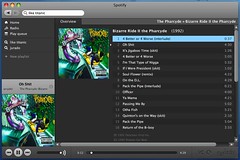
I wrote about Spotify about a year ago, after trying the service. Spotify is a great music software offering free ad-supported music streaming with an iTunes-like interface, a growing database and instant on-demand access to the music you save in your playlists or discover using the search or “similar artists” features. If you want no ads to interrupt your music you can pay for a subscription (9,99€/month) or buy a day pass (probably a good option if you are planning a party).
After a closed beta period, Spotify is gradually opening to users around the world, and is now available in Spain. For those of you who live in this country, you can subscribe and download the client from this address. For those who live in countries where Spotify isn’t available yet, Michael Arrington posted about a way to get Spotify anyway, give it a try.
![Reblog this post [with Zemanta]](http://img.zemanta.com/reblog_e.png?x-id=9f74f82d-08e9-4ec9-93c5-c6655c0074f0)
2009 21
Innovate! Europe’s program helps tech startups go global
Published by MartinVarsavsky.net in General with No Comments
Life for a tech startup in Europe is not always easy, especially in these tough economic conditions. One of the key challenges European startups have to face is going global. Luckily there are initiative like SeedCamp and Guidewire Group’s Innovate! Europe that can help. Innovate! has a three-part program designed to identify Europe’s most promising startups and accelerate their drive into the global technology market. During this European talent search startups will receive mentoring and promotion while competing against other aspiring startups. Hundreds of companies will apply. Only one will be named the top startup in all of Europe. Executives from the winning startup will have the opportunity to benefit from knowledgeable mentors, to reach new investors and to form strategic partnerships to help grow their business.
For your startup to qualify you need to be in the information technology, Internet, mobile and digital media sectors and be ready to expand out of your home market.
The first step is to apply online for an invitation to participate in one of Innovate!Europe’s complimentary Going Global Workshops. The most promising companies are invited to local Going Global Workshops, where Guidewire Group’s expert analyst team will give you feedback on your company’s competitive value proposition and market opportunity, and help you hone your pitch and the skills you need to best compete in fast-paced markets like Silicon Valley.
Going Global free workshops are scheduled for February the 4th ‘09 in Dublin, Ireland and February 5th in London, UK. Going Global Workshops will also take place in Paris, Berlin and Bern in late-March and early April
The most promising companies who participate in Going Global Workshops will receive free online promotion and exclusive invitations to next phase of the program: Innovate! Europe’s Master Class, taking place in Zaragoza May 4th-6th, where they will prepare to go global. Taught by serial entrepreneurs, financiers and experts from Europe and the United States, the Master Class curriculum will highlight proven strategies and best practices that are integral to becoming a successful global entrepreneur.
The top graduates of Innovate!Europe’s Master Class will have an opportunity to accelerate their business in Silicon Valley as participants of the Innovate!Europe Trade Mission. Innovate!Europe will culminate with the selection of one European startup that shows the greatest potential to shine on the global stage. That company, which will be selected by the Innovate!Europe’s Master Class faculty, will win a free spot at Guidewire STUDIO, an in-residence business accelerator in the heart of Silicon Valley.
For further details on the Innovate! program, visit their website.
2009 19
Why is the President of USA the President of the World?
Published by MartinVarsavsky.net in General with No Comments

- Image by Getty Images via Daylife
Because, the USA is a very federal country and there´s little a President can do to change the way America is going other than by convincing Congress, Governors and Mayors to go along with him.
Because, the only area in which a US President really has power is in the military and foreign policy.
Because, the EU, which could be a true military rival of USA, not in the sense of enemy but in the sense of forcing USA to act in sync around the world, doesn´t really have a post WWII vocation for the role.
Because, China is not there yet.
Because, the UN is ineffective and little countries have an absurd amount of power. The UN never came up with the Senator/Representative solution to distribute world power. It either has the veto concept by very few countries that are too powerful, or it has the one vote per country that gives little countries too much power.
Because, America is the biggest global exporter of culture and most movies – TV shows do a great job at promoting the image of the US President around the world.
Because, the authority of the US President is so resilient that not even George W. Bush was able to destroy it. Bush had a significant chance to improve the state of the World and he did the exact opposite. He inherited a world mostly rich and mostly in peace and he and his administrations made such wrong decisions that the world is now less rich and less peaceful. Obama has a chance to change the course.

2009 16
Bravo Yat Siu!
Published by MartinVarsavsky.net in Micro with No Comments
At a time when it´s so damn hard to make deals, my friend, Yat Siu, who is also our chief fonero in Hong Kong, among many other exciting activities, just sold one of his companies, Outblaze, to IBM. Genio!
2009 16
Antarctica is for everyone
Published by MartinVarsavsky.net in General with No Comments
Antarctica is uninhabited. Nowadays there are only about 5,000 people –mostly scientists– who go there during the summer and about 1,000 who winter over, spread out among the many research stations located on the vast continent. The lack of people is simplys because Antarctica is incredibly inhospitable. Antarctica is much colder than the Artic because not only it contains the South Pole but unbeknownst to people is the fact that Antarctica is the highest continent in the world. While ice floats in the Arctic, in Antarctica it is supported by the continent, which causes it to reach unexpected heights.
Most of the countries of the world accept that Antarctica belongs to all mankind, and many treaties to keep it untouched have been signed, with some being supported by NGOs like Greenpeace. But a few countries, among them Argentina, Chile, France, Norway, New Zealand and Australia, seem to believe that a piece of Antarctica belongs to them. As an Argentinean, I’ve experienced this confusion. They didn’t teach me at school that Antarctica was a continent that the majority of the planet –-except for a few countries, including my own-– believes belongs to them. What’s more, when I was a kid they told me that there was a part of Antarctica that belongs to Argentina, as if it were a fact, and not that the United Kingdom and Chile also argued that part of that same territory was theirs, while the majority of humanity said that it was everyone’s. And it looks like that feeling, associating Antarctica as part of the Argentinean homeland, continues to this day. Case in point: Today I was surprised to see that a former collaborator of Fon, Juan Kestemboin, is about to head to Antarctica with a friend, Mariano Rabinstein, and to read how the Argentinean media is covering what will have to be told as an adventure as if it were an act of patriotism. It looks like Juan and Mariano are saying that they are going to visit the Argentines who are spending the winter “serving their country” in Antarctica. Fortunately, I later saw that they have a sense of humor about it in their blog. I assume that John and Mariano also realize that, since Argentina already has so much territory –-with which it has done relatively little-– finding more land at the pole is not on the list of priorities to help the country move forward. Argentina is almost a third of the size of the United States, but it only has about 13% the number of inhabitants, and its GDP is a mere 2% of the USA’s. In turn, the USA, which doesn’t generally shy away from sticking its nose out beyond its own borders, hasn’t actually laid any claims to large swaths of the polar continent. Rather, it has directed its resources to its successful Antarctic Program, which has been crucial to the fruitful scientific research carried out on the frozen continent, whether it be near the coast at McMurdo Station, or at the true bottom of the Earth: the Amundsen-Scott South Pole Station.
To me, what the Argentineans have to do is help manage Antarctica, and the easy access that Tierra del Fuego offers to the only part of the continent that is sometimes not so cold. As it stands, Christchurch, New Zealand serves as the USA’s gateway to the Antarctic, even though the city is a long, five hour flight away from McMurdo. In other words, Argentina has to lead by example: work together with the rest of humanity. I believe that the other countries who say that they own part of Antarctica should do the same. The best thing would be for everyone to withdraw their claims, and for Antarctica to be run by the United Nations, in the process becoming a source of revenue for Argentina, as it has a strategic location for conducting expeditions and promoting sustainable tourism. Yet the word “sustainable” is crucial, since Antarctica’s near-pristine state, in addition to its extreme cold and thin atmosphere (as a result of its high elevation), is what makes it such an ideal location for scientific research. Then again, this is exactly why everyone should withdraw their claims, so a greed-driven and environmentally-damaging free-for-all does not ensue.
I will finish by telling the absurd story of the Argentinean soldiers who sent a woman who was seven months pregnant to Antarctica in order to ensure that Argentina had the first baby born on the mainland, and of the Chileans who did not want to be shown up, and some years later had their own polar baby.
Emilio Marcos Palma was the first person born on the Antarctic mainland, at Base Esperanza in 1978, his parents were sent there along with seven other families by the Argentine government to determine if family life was suitable on the continent. In 1984, Juan Pablo Camacho was born at the Frei Montalva Station, becoming the first Chilean born in Antarctica. Several bases are now home to families with children attending schools at the station (all from the same “Antarctica” article on Wikipedia).
What I’m wondering now is, since granting citizenship to the grandchildren of Spaniards (depending on which side they were on during the civil war) is currently in style in Spain, if it is possible that Spain will end up also having a polar baby, whether it be due to Palma or Camacho’s lineage.
To me, it’s clear that Argentina and Chile have a great opportunity – not to compete, but to work together to develop a type of Antarctic tourism which, if well organized, could come to be a good extension of Patagonian tourism.
2009 16
Dopplr and Obama´s trips, a cool demo
Published by MartinVarsavsky.net in General with No Comments
Dopplr, a company I have invested in, has created what they call a Personal Annual Report for their users. Dopplr is a social travel site that lets frequent travellers share future travel plans with friends and colleagues. The Personal Annual Report is a PDF that gives you interesting data and visualizations about your travels in the last year. They’ll send it next week to all their users via email.
To give an example they created a Personal Annual Report for somebody who traveled a lot last year, President Elect Barack Obama. You can download his report here.
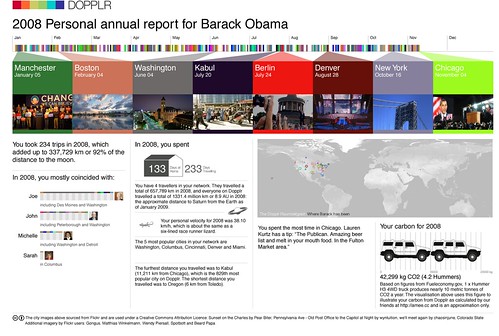
Your report will include Flickr images for the places you travelled to and a number of other information like other Dopplr users that travelled to the same places you did and an estimate of the carbon emissions generated by your travels. They chose a clever representation for the environmental impact of your travelling: they tell you how much CO2 you produced compared to the yearly output of a Hummer SUV.
2009 15
Businesses can be created without VCs
Published by MartinVarsavsky.net in General with No Comments
There are plenty of businesses that were “jump-started” into operation, without VCs or with minimal investment. A few examples of these businesses in Spain are Meneame and Panoramio now part of Google Earth, while in the U.S. there’s Digg. And of course, there are many more throughout the whole world. As the crisis hits us all this is one of the topics that I touched upon during my latest lectures with future entrepreneurs.
Right now startups are being made Open Source style: everyone puts in a little bit of their time. And this is partly feasible because Open Source itself exists nowadays: programming requires fewer resources than before, hosting is cheaper, hardware in itself is cheaper. Open source apps lowered the barriers to putting products on the Internet, and the Internet is now ten times bigger than it was at the time of the last crash. Indeed, here is a little tidbit of information for you: In 2007, YouTube alone consumed as much bandwith as the entire Internet in 2000.
2009 15
Google Docs: Apps on the Internet is finally here
Published by MartinVarsavsky.net in General with No Comments
Ever since I founded Einsteinet in 2000 and began to promote the concept of an intelligent Internet, I’ve been obsessed with the idea of being able to do everything from the web browser itself. Although I lost $50 million on Einsteinet mainly because I was five years ahead of the game, I haven’t lost that passion for seeing the day come when all I need to do is open Firefox, and everything will take place right there and in the cloud (or the brain as we used to call it back in 2001). And although Zoho is good, I still think that the people who are closest to giving us an intelligent Internet are the folks at Google, with many of their applications, and especially Google Docs (disclosure: Google are investors in Fon).
I had to give a presentation recently and I decided to do it with Google Docs. It ended up being incredibly easy to be in Firefox with many tabs open and add photos from the Internet to my presentation (searching via Google images) by simply clicking on a photo and dragging it to the Google Docs tab. You can also use your own photos and videos with ease, and it is even easier to use photos from the Internet, or videos on YouTube. The format of each photo adjusts accordingly. And when it comes to speed, forget about using Power Point, Keynote or Neo Office on a Mac. Now, what I wasn’t able to do is receive a presentation in my Gmail account and save it directly in Docs without first downloading it onto my computer and uploading it later to Google Docs. But what you can do is just send it to yourself at a special email address and keep it uploaded in Google Docs.
On most common apps, on what used to be Word, Power Point, Excel, Outlook, Google Docs, Gmail are all you need now. And they work especially well with Netbooks connected to WiFi or HSDPA. My favorite netbook? The Dell Mini with Ubuntu.