
2007 26
With Khaled Hosseini at the World Premiere of Kite Runner
Published by MartinVarsavsky.net in General with No Comments
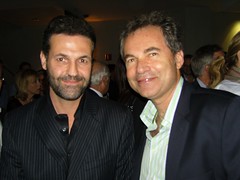
Tonight I attended the world premiere of The Kite Runner. Here´s the background of the movie from the Wikipedia as well as the background on the novel that inspired the movie.
The Kite Runner tells the story of Amir, a well-to-do Pashtun boy from the Wazir Akbar Khan district of Kabul, who is haunted by the guilt of betraying his childhood friend Hassan, the son of his father’s Hazara servants. The story is set against a backdrop of tumultuous events, from the fall of the monarchy in Afghanistan through the Soviet invasion, the mass exodus of refugees to Pakistan and the United States, and the Taliban regime.
The movie is a must see. It´s well acted by Farsi speaking actors who are now involved in a controversy that could actually be part of the movie itself. It turns out that the child actors and their parents who are unable to separate fiction from reality are now concerned that the rape seen that is not graphic and looks more than a beating than a rape will make it impossible for the child actors to go out and meet with their friends who will think that they were actually raped. If anything this type of world view by the actors and their parents complements what the movie portrays and that is that Afghan society is extremist in its views and unable to distinguish symbolism from reality. The story of the characters in the movie is a story of pride, guilt, abuse, humiliation, extreme violence. One unusual element in the story is that that this movie is mostly a story of men. The only potent seen with an Afghan woman is one in which all you see is this woman getting brutally stoned to death.
2007 26
David Karp’s Tumblr
Published by MartinVarsavsky.net in General with No Comments
In this video I interview David Karp, co founder of Tumblr. Now you have probably heard about the MBA drop out who goes out and starts a company, you have probably also heard about the college drop out who goes out and starts a company, now how about the high school drop out who leaves to start his company and then by the time he´s 21 he is on to his second start up: Tumblr. So what´s Tumblr? How about WordPress meets Netvibes, meets Facebook, meets Twitter and they all get along? Tumblr is….well…it´s Tumblr and there´s nothing like it. You can see my Tumblr here. If you follow that site you will see feeds every time I post in my blog, or I post videos, or I post pictures on Flickr. It´s like a Netvibes of my own production. And here is David´s.
Myspace and Facebook have won. Second Life has lost. Myspace and Facebook proved that while people love anonymity on the Internet above all, they want to show off, they want to share a lot about themselves. And this is even more the case for the worlds 50 million bloggers, a few of whom are anonymous.
Now if hundreds of millions of people around the world want to promote themselves and sometimes share the most intimate details of their lives, why is it that there´s so much fuss on the internet about privacy? My take of this is that most people are not privacy freaks, nor do they live in fear of others finding out about themselves. If they did they would be all with secret identities somewhere in Second Life or other sites that promote anonymity.
Last week Eric Schmidt, CEO of Google, wrote an article in the Financial Times asking the United Nations to work on a set of global guidelines on privacy.
2007 13
s.technorati.com
Published by MartinVarsavsky.net in General with No Comments
I am an investor in Technorati and I am sorry to see that Dave Sifry left the day to day management of the company. I am also sorry to see that now “authority” as a concept has been taken out from the home page of Technorati and relegated to www.s.technorati.com a hack that few know. Now if I was advising Technorati this is what I would say.
Read More
2007 13
90% of Chueca is covered by Fon Signal
Published by MartinVarsavsky.net in General with No Comments
El Mundo, Spain´s largest news web site, announces today that Chueca, Madrid´s gay neighborhood is 90% cover by Fon WiFi signal. I personally want to thank the leaders of the Gay Community of Madrid and the Gay Press Zero for believing in Fon and making this a reality. Moreover I would like to invite all of those who visit Madrid to hang out at the Fon WiFi HQ in Chueca and enjoy the neighborhood with their laptops, PSPs, DS, iPhones, Nokias, Sony Ericsson´s, HP´s, HTC´s or whatever WiFi gadgets they may have!
2007 13
Hatzalah: you too can save lives
Published by MartinVarsavsky.net in General with No Comments
On the way back from Beijing I had a chance to fly with Neil Goldman, a co founder of Capital IQ who is now both a fund manager and a philanthropist. Neil shared with me that he supports of Hatzalah. Coming from Fon a global WiFi network built by the people and interested in all efforts that involved citizen participation (see my previous article on Couchsurfing) I thought that the idea of training regular citizens to save lives was quite powerful. The basic idea of Haftzalah is that without much training all of us can save lives and while it would be ideal of course that only very well trained medical personnel saves lives it so happens that many times by the time qualified medical personnel arrives it is just too late. So Haftzalah trains anyone in Israel, say a marketing manager at a tech company, to save lives. And she may be at a meeting explaining how to launch the latest Web 2.0 service but when her phone rings, she drops everything a la Superman and goes to save lives, at least until the MDs arrive. One of the biggest life savers is in the use of defibrillators. As the Hatzalah web site describes:
AUTOMATIC EXTERNAL DEFIBRILLATOR
These machines automatically detect heart rhythms and can shock a patients heart back into beating.
My father died of a heart attack when he was only 49 in an intercontinental flight and I certainly wish that there had been a defibrillator on board and regular citizens trained to deal with them. I was also pleased to see that this concept was extended to the US and it is somewhat similar to that of being a Red Cross Volunteer but even more grassroots.
2007 13
Couchsurfing: share your couch, roam the world
Published by MartinVarsavsky.net in General with No Comments
Nina who works with me pointed out this site called Couchsurfing. Its like a Fon but of couches. With Fon you share a little WiFi out of your window with those who pass by and then they share with you when you go by their home. With Couchsurfing it gets more intimate. You share your couch with those who pass by and they share their couch with you when you travel. Even though I am not sure I am ready to share my couch(es) with those who pass by my home I loved the idea.
2007 12
Why are US Police Forces so rude?
Published by MartinVarsavsky.net in General with No Comments
I am not a US citizen but I lived in the US for 18 years. I now live in Spain. As CEO of Fon, the largest WiFi network in the world, I frequently travel around Europe, Asia, and America. In my travels I have had a chance to compare countries along a lot of different categories. Indeed during long international flights I started a comparison chart between Europe and USA along around 50 different categories that were meant to define which part of the world had better quality of life. These included issues such as access to education, quality of health care, criminality, unemployment, level of red tape, income per capita, job opportunities, innovation rates, tolerance and other random categories. Interestingly the result was pretty even between Europe and USA: there were around 25 categories that USA scored better and a similar number for the EU. My conclusion was not that the EU was better than USA or viceversa but depending on what is important to you you would choose one over the other. And I chose Europe. Now having said this there was one issue in which Europe had the upper hand and that was the quality of the Police Forces and the justice system in general. For reasons that are not clear to me USA has much higher incarceration rates than Europe. Indeed USA has more people behind bars than Madrid has inhabitants, about 4.4 million vs 5.7 million. But not only USA has abnormally crowded prisons (if incarcerated people were included in unemployment statistics USA would lose its advantage in employment vis a vis Europe), but USA has a Police Force that is particularly rude in the treatment of its citizens. During a visit to Southampton, Long Island I was shouted at by a policeman for a minor traffic violation (driving at 42 miles an hour in a 30 mile zone). When I got off the car to apologize I was almost handcuffed. The “hands on the wheel” diatribe was so bad that it made me wonder how US citizens put up with Police Forces that so frequently abuse individuals. I don´t mind getting a fine but I do mind being treated like a dangerous suspect when any security officer with common sense would not consider me in a bathing suit a real threat. Moreover not only are US Police Forces rude but they are corrupt as well. When I was telling a friend how I was shouted at in Southampton she metioned that there is a well know way to be treated well by US Police Forces and that is to pay them off. But as opposed to giving them cash on the spot the system, and it seems to be a very well accepted system nationwide, consists in making significant payments to the Police Charities and obtaining badges that say that one is a contributor to the Police Forces. Indeed so interested are US citizens in trying to get a better treatment from their police forces that many fall into various scams. My take as a frequent visitor to the States is that this system is shameful and that Police should both stop being rude to average citizens and certainly stop taking what in other countries would clearly be called a bribe in the form of charitable donations.
Tonight, Lars Hinrichs, from Xing, and I went out for a walk. We wanted to go from the Grand Hyatt hotel to Tianmen Square. The walk was dissapointing. Not only were we approached by many women who were offering their services to us, but as the video that I include here shows, we also saw many homeless people sleeping on the street right outside the fanciest shops in Beijing. I should say though that during the 18 years I lived in NYC I also saw tremendous poverty coupled with extreme wealth, something less common in Europe. I guess by now the most socialist region left in the world is Europe, and curiously Japan. The rest of the world has a worse distribution of income. China which has no socialism left really, it is going for the extreme capitalist model. I wish it moderated it. China should adopt a European or Japanese model of development that balances capitalism with the welfare state. I do not believe that extreme poverty is necessary to generate growth. Korea is also another country that proves that enormous income differentials are not needed for a country to grow out of poverty.
2007 10
Zhang Rui’s Chinese contemporary art collection
Published by MartinVarsavsky.net in General with No Comments
In this video I show the home of Zhang Rui, one of China´s top art collectors. The video was filmed yesterday at the inauguration party of Zang Rui´s Guggenheimesque home. The collection is amazing. It does contain some art that may offend Christians. My apologies in advance for this.