
Thanks to Iurgi from FON, I received a link to Gizmodo where Jesús Diaz gives a good summary on how to unlock an iPhone from AT&T and use it in Spain. At the end of his post, Jesús explains:
[the iPhone] is the best telephone I have ever used, light years away from the Nokias, Sonys, Samsungs, and other junk. That is exactly what those telephones look like after trying the iPhone: junk.
So let me explain, Jesús, my experience with the iPhone. I was just as enthused when I started to use the iPhone, but within a month I had already gone back to the old combo of the Blackberry and a Nokia that I’ve been using for the past few years. I know that carrying around two phones, one of work and one for pleasure, sounds absurd, but I get around with the Blackberry 8800 and the Nokia N95. During the month I used the iPhone, I carried around all three phones, until my iPhone was stolen at a party in Mallorca. I am sorry but could never get by on the iPhone alone. Actually, it got to the point where I only used my iPhone to look cool whereas I used the other phones to do things. When my iPhone was robbed, many of my commentators asked me why I was carrying it around with me if it didn’t even have service Spain. Well the iPhone did have roaming service from AT&T in Spain but the roaming fees were so high that I only carried it around to show it off and occasionally to see things as the iPhone´s forte is that it is the world´s best spectator phone, great to see what others did (Youtube button) extremely poor when you want to be the protagonist (does not allow you to shoot your own video). In any case here´s a list of reasons as to why I am not replacing my iPhone. Read More
The major software companies including Apple, Microsoft, Adobe, Dell, Symantec, HP, IBM, Intel and McAfee, founded a group called the BSA (Business Software Alliance). They define themselves as “the voice of the world’s commercial software industry and its hardware partners before governments and in the international marketplace”. BSA programs foster technology innovation through education and policy initiatives that promote copyright protection, cyber security, trade, and e-commerce”. In fact, one of their campaigns they run worldwide is to encouraged employees to denounce their companies and employers that use piracy software, such as copies of microsoft, antiviruses and other privative software. and they have become quite succesful in their task in places such as Germany, where quite a few employees contacted them.
This is not a problem we have at FON since last May we decided to drop Microsoft and adopt Ubuntu. We did this to save time, maintenance costs, license costs, to be able to use hardware for a longer time, to have access to quick updates, to operate in a secure, virus free environment. But now that I know that Microsoft and others were asking employees to denounce Fon, I feel even happier that we are using open source software.
2007 1
Geography of Social Sites on the Internet
Published by MartinVarsavsky.net in Internet & Technology with No Comments
One of the amazing things about the Web 2.0 sites is that their founders seem to have no clue as to where success (their community members) will come from. It’s one of the facets of globalization: one can succeed in the least expected place. I found a map describing this phenomenon in the case of social networks. Lucas Shaw from Wandamere is its author and it was published by Valleywag.
Using Alexa data, this map of the World shows how different sites position themselves in different countries. Bebo dominates in Australia and New Zealand; Blogger in Iran and Spain; Fotolog in Argentina, Chile and Uruguay; Orkut in Brazil, India, Pakistan and Paraguay; LiveJournal in Russia and Belorussia; Facebook in such different countries such as: Canada, Egypt, Jordan, Norway, Panama, South Africa and the United Kingdom. SkyBlog is very successful in

2007 12
Seedcamp: a great opportunity for start ups
Published by MartinVarsavsky.net in Internet & Technology with No Comments

I am delighted to announce the launching of Seedcamp, an idea of my friend Saul Klein, that I think is great. Seedcamp will take place in
From all signed-up entrepreneurs, 20 will be chosen to participate in the event. And at the end of the week, 5 of them will be offered an investment of €50K , which will be considered equivalent to a 10% of the company. Entrepreneurs who accept this offer will move to
2007 6
The Facebook traffic jam
Published by MartinVarsavsky.net in Internet & Technology with No Comments
While I am on the record for saying that Facebook will become the number one social network in the world and will sell for over $10bn and I still believe that Facebook will do to social networks what Google did to search, as I use my own Facebook I am beginning to see some real problems. What follows is a list of the biggest challenges that I see as a Facebooker.
2007 24
Facebook will be worth over $10bn
Published by MartinVarsavsky.net in Internet & Technology with No Comments
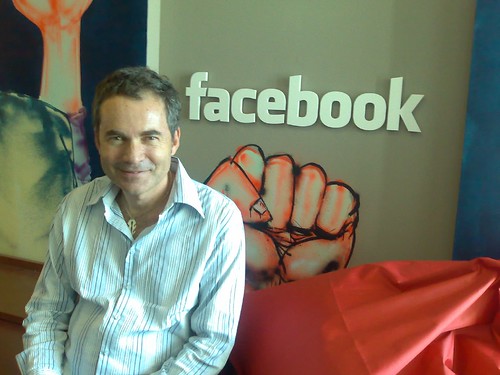
There are many reasons why I believe that Facebook will be worth over $10bn, maybe as much as $20bn but I will focus on one, its open immigration policy. Joanna Rees (CEO of FON USA) and I went to see the folks at Facebook in order to make a deal on how Fon could appear in Facebook. The visit was amazing in the sense that we basically learned that we could do whatever we wanted at Facebook. All our ideas were greeted with a yes, yes and yes.
Basically, the Facebook system resembles a country with open immigration in which the best are allowed to thrive, kind of like USA who manages to attract the best of the best…and thrives. But of course you have to live by certain rules like for example disclosing who you are, a rule that we also have at Fon and that while potentially hackable Facebook told us that they frequently delete accounts of people they believe are not disclosing their true identity. Interestingly Second Life has the opposite principle, namely that people would like to live in an imaginary world of second identities, and some do, but most like to have a real relationship with real friends.
To me there´s no doubt that Facebook will be hugely popular and will overtake Myspace sometime during 2008 and become the largest social network in the world. The only lingering doubts center around monetization but with Google nearby and with the famous Myspace Google deal as a starting point I see that selling ads to people who disclose their identity and so much about themselves will be like shooting fish in a barrel.
2007 22
Undivided Attention is a Thing of the Past
Published by MartinVarsavsky.net in General with No Comments
I am at Supernova and as I watch almost all attendees work on the Internet while they “listen” to the speakers, I conclude that “undivided attention” is a thing of the past.
2007 22
At Supernova with AOL and Yahoo
Published by MartinVarsavsky.net in Internet & Technology with No Comments
I am at Supernova in San Francisco. I just spoke at a panel on social networks in which AOL and Yahoo were represented. AOL has over 100 million unique users, mostly in America. Yahoo has around 400 million uniques with USA being it´s number one country as well. And other than Flickr my guess was that most people in the audience did not use AOL, nor Yahoo. Also other than Flickr I could not see how any AOL or Yahoo properties benefit from the Web 2.0 effect, namely that your experience gets better on the net because somebody else is surfing the same site as well.
But if anything AOL and Yahoo were eye openers to me in the sense that I wonder how elitist many of the sites that I invest in are. Companies like Technorati, Netvibes, Joost and many others are much smaller than Yahoo and AOL and have little chance to ever catch up with them. So is the Web 1.0 just here to stay? Is the Web 2.0 a minority group that just looks huge to us because we live in it but it is tiny when all is taken into account on the internet? Or will AOL and Yahoo eventually evolved and make most of their experiences comunal? Hard to tell.
2007 16
Virtual Philanthropy: The Stardoll Case
Published by MartinVarsavsky.net in Internet & Technology with No Comments
Before the digital era there was only way to be poor and that was not to have access to things. But now there´s a new kind of poverty and that is digital poverty. Not only can you be poor because you have no access to the information society as we like to call it in Europe but even inside the Internet you can be poor. Let me give you a concrete example of digital poverty. It relates to Stardoll. Stardoll is a very simple yet incredibly successful site for little girls to dress up their dolls. I first blogged about Stardoll in April of 2006 both in English and Spanish What happened to me after blogging about Stardoll in Spanish is that because of my Google Ranking when you google Stardoll only in Spanish you come to my blog. But what´s unusual about Stardoll is that even though doll´s are virtually dressed in Stardoll their virtual clothes cost real money. And what I frequently get now is e mails from little girls from Spanish speaking countries who ask me if I can please give them stardollars so they can buy dresses for their little dolls. And I feel so sorry about them that I even contemplated that my foundation could finance some of these but came to the conclusion that that would be absurd. Interestingly, yesterday, I had a chance to see Mattias Miksche from Stardoll again and raise this issue. Since there´s little cost involved in producing these clothes. Couldn´t we start an NGO that actually gave them for free or for practically nothing to poor girls in say Ecuador, Peru, Colombia? And in general, now that wealth is both felt (no food) and perceived (Swedish girls can buy clothes, Peruvian girls can´t), don´t we have an opportunity in the virtual world to do virtual philanthropy and make a lot of little girls, boys, and even grown ups happy? Mattias did not give me a concrete answer but I am sure he is thinking about this. Personally I think that there is a chance of bringing digital justice to this world. Pricing digital property in terms of the average purchasing power of each country would be a good start. Cause as opposed to real property digital property has no cost for an extra copy. Let´s take advantage of this and start the digital fair trade movement!